
Every few months, I find myself in a conversation with someone from the B2B world who explains, patiently, why the marketing principles I’m talking about don’t really apply to them. “Our buyers are rational. Our cycles are long. Our decisions are made by committees, not individuals. We don’t need brand — we need pipeline.” And I nod, and I listen, and I think: you’ve just described the most expensive permission slip in marketing.
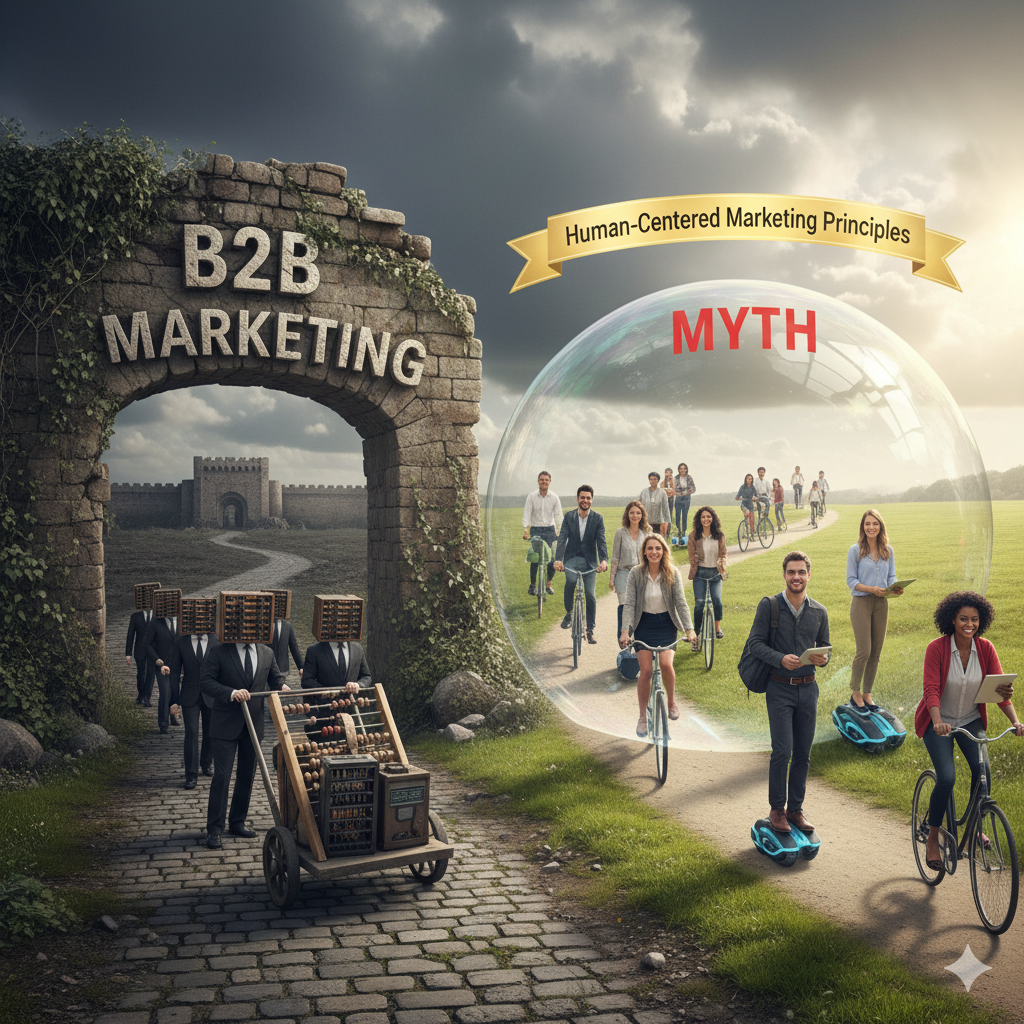
The idea that B2B marketing operates by fundamentally different rules has become one of the industry’s most comfortable myths. It has spawned entire consulting practices, acronym-heavy frameworks (ABM, MQLs, SQLs…), and a collective decision to quietly skip the brand-building parts of the job. The problem is that the evidence doesn’t support it. And some of the sharpest minds in the industry have been saying so for years.
Even Mark Ritson Is Tired of the Question

Mark Ritson has been asked some version of “but does this apply to B2B?” more than 1,000 times in his career. His verdict, published in Marketing Week in 2024, is about as direct as it gets: the question is fair, but it’s also dumb.
His argument is worth unpacking. Most marketing examples use B2C brands — Guinness, Gillette, Nike — not because B2C is more important or more interesting, but because it’s faster to set the scene. Explaining a dialysis equipment tender takes four hours; showing a pint of Guinness takes four seconds. The pedagogical shortcut gets mistaken for a strategic divide.
More importantly, Ritson points to the work of LinkedIn’s B2B Institute, which has spent the last several years applying B2C theory — Binet and Field’s long and short, Byron Sharp’s mental and physical availability, distinctive assets, double jeopardy, emotional advertising — to B2B categories. The finding: these concepts not only work in B2B, they often work better. Salience, category entry points, ESOV, creativity — the whole toolkit translates.
And there’s a second point in Ritson’s piece that I find even sharper. The entire “B2B is different” argument assumes that B2C is somehow a uniform discipline. It isn’t. Selling handbags, home insurance, ice cream, and industrial software are all “B2C” — and they have almost nothing in common tactically. The variation within B2C is no smaller than the variation between B2C and B2B. A marketer who sells Cornettos doesn’t raise their hand at a conference to ask whether the software case study is really applicable to them. Only B2B marketers do that. And it’s a habit worth dropping.
The Rule That Was Built on B2B Data
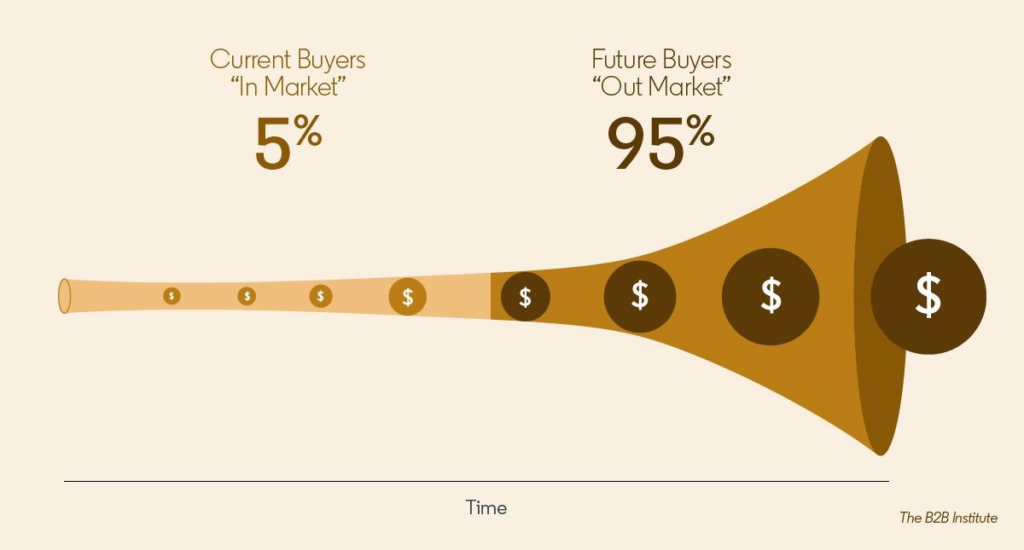
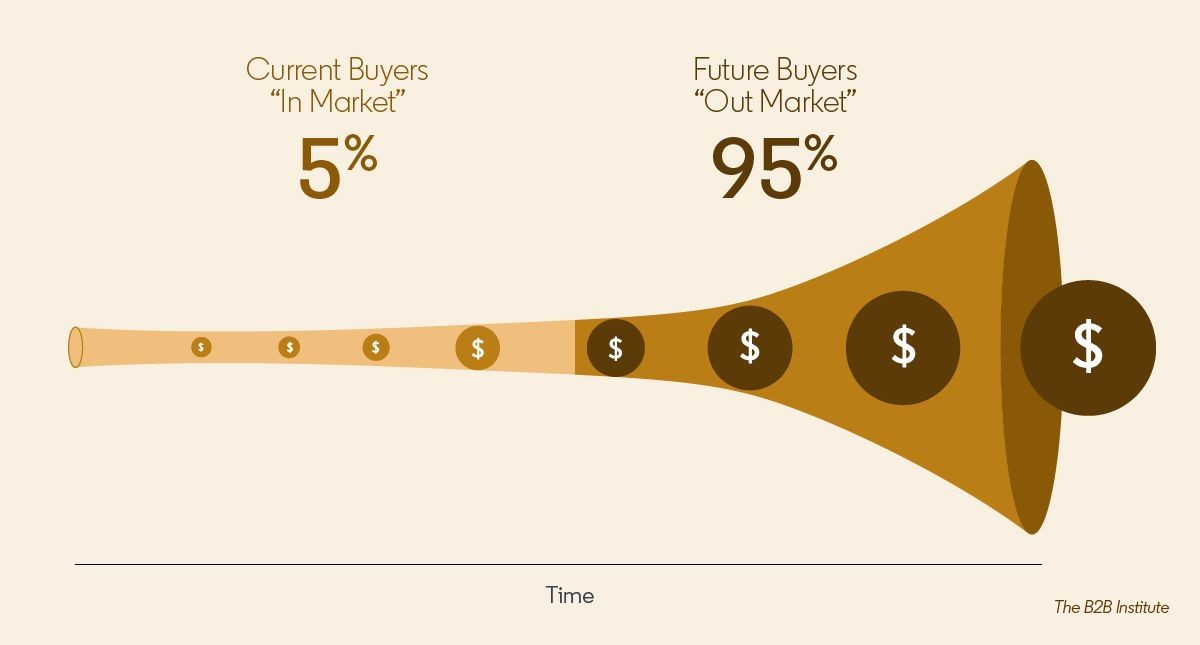
Here’s the irony nobody in the demand-gen world wants to talk about. The 95/5 rule — probably the most important reframing of how advertising works in the last decade — was developed from B2B purchase cycle data. Professor John Dawes of the Ehrenberg-Bass Institute introduced it in 2021: at any given moment, only 5% of potential buyers are actively in-market. The rest are not shopping. They are not reading your white papers. They are not filling out your lead forms.
In B2B, where replacement cycles for software or industrial equipment can run five, seven, ten years, the share of buyers in-market at any given quarter can be well below 2%. The conclusion is not that B2B needs different rules. It’s that B2B needs better brand building — because your future buyers need to already know and trust you before the buying window opens. When it finally does, they reach for the brand they already know.
B2B doesn’t need less brand building than B2C. It needs more. The very thing that makes B2B buying supposedly “different” — the long cycle — makes the case for brand investment stronger, not weaker.
The Rational Buyer Is a Fantasy
There’s another assumption baked into the myth: that business buyers are purely rational. They evaluate options systematically, run procurement processes, and are immune to brand preference. I honestly find this hard to believe. The person signing a six-figure software contract is a human being with a career and a reputation on the line. Familiarity reduces risk. Trust reduces friction. “Nobody ever got fired for buying IBM” is not a rational calculus — it’s mental availability at work.
Zoom is a useful illustration. The company has 99% brand awareness and still had to fundamentally rethink its brand strategy. Kim Storin, Zoom’s CMO, described the problem clearly: awareness had become a ceiling, not an asset, because Zoom was only top of mind for one use case. The rest of their product suite — CX, webinars, AI workflows — was effectively invisible. Their solution was rebuilt mental availability across buyer segments, brand health measurement, showing up where buyers do research. This is indistinguishable from what any B2C brand would need to do. B2B buyers now complete 80% of their research before ever speaking to a brand. That research window is a brand-building window.
The Real Difference Is Political, Not Strategic
Peter Weinberg and Jon Lombardo from LinkedIn’s B2B Institute put it plainly in a 2021 Marketing Week piece: strategically, B2B and B2C are the same. The biggest difference isn’t about buyers or categories — it’s about internal politics.
At B2C firms like Unilever or P&G, marketing holds real authority. In most B2B companies, the marketing department is a sales support function. Product leaders believe the product sells itself. Sales leaders want cheap leads by tomorrow. Brand investment doesn’t fit neatly into a quarterly pipeline dashboard. So it gets cut — not because it doesn’t work, but because the internal power structures aren’t set up to value it.
This is the honest explanation for why the B2B marketing myth persists. It’s not that the evidence points to a different discipline. It’s that B2B marketers often can’t get the budget for brand building, and over time, a political constraint gets dressed up as a strategic conviction.
To sum up:
The distinction between B2B and B2C marketing is not a strategic insight. It’s a permission slip — one that lets B2B marketers skip the hard, slow, unmeasurable work of building a brand that people actually want to buy from. The 95/5 rule, which was built on B2B data, tells us what to do: invest in the 95% who are not buying yet, because they will be eventually, and they’ll choose the brand they already know.
As Ritson put it: the next time someone asks whether any of this is applicable to B2B, the only honest answer is — you bet your life it is.
BUSTED.