
We keep running into the same slide. “Your next customer is an AI agent.” It comes with a big number attached: McKinsey projects $3 to 5 trillion in agentic commerce by 2030 (eMarketer). The logic sounds clean. Software finds, compares and buys products for people, so brands must now market to software. We have seen a similiar slide with a similar claim even before. In 2018 it said “voice”. So we checked what happened to the voice commerce forecasts, and what the first real agentic data shows today.
What is agentic commerce?
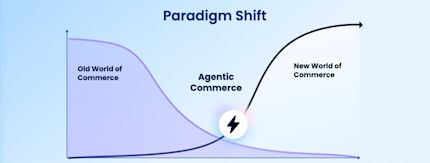
Agentic commerce means AI agents find, compare and buy products on behalf of a consumer. The person sets a goal, say a waterproof jacket under 200 euros, and the agent does the shopping. Everyone is building the plumbing. OpenAI launched Instant Checkout with Stripe’s Agentic Commerce Protocol in September 2025. Google and Shopify followed with the Universal Commerce Protocol in January 2026. Amazon added Auto-Buy and Buy for Me in May 2026 and keeps the transaction inside its own walls, after suing Perplexity in November 2025 over agents shopping on amazon.com (Digital Applied). Shopify and Amazon restrict outside agents on their platforms (eMarketer). Even the platform owners do not want to hand over the checkout.
We have seen this film: voice commerce
In March 2018 OC&C Strategy Consultants predicted that voice shopping in the US and UK would grow from about $2 billion to more than $40 billion in 2022. Even TechCrunch called that “a bit optimistic”. A year later Juniper Research went further: $80 billion in 2023, built on eight billion voice assistants in use (Voicebot). Juniper counts assistants per installation, so one phone running three assistants counts three times. A forecast built on device counts is a forecast about hardware. It says little about shopping.
Now the reality. In August 2018 The Information reported, citing people briefed on Amazon’s internal figures, that only about 2% of Alexa device owners had bought anything by voice that year. About 90% of those buyers never tried again (Gizmodo). Surveys looked friendlier: Voicebot found 16% of smart speaker owners shopping by voice every month. Amazon’s own data said 2%. Self-reported behaviour versus measured behaviour, as usual. In September 2020 a Bizrate survey found 2% using voice shopping regularly and 63% neither using it nor interested (eMarketer). In 2022 leaked documents showed Amazon’s Worldwide Digital unit, home of Echo and Alexa (and Prime Video), on pace to lose about $10 billion for the year (Insider, via Strata-gee).
We also went looking for the actual voice commerce sales figure for 2022 or 2023 to put next to the forecasts. We did not find a published number anywhere near $40 billion. Of course, a missing source is not proof. But a market of that size would have a tally, and nobody advertises a miss. Our conclusions: the forecasts assumed that technical capability equals consumer demand. Namely that people want to hand over the transaction. Without a screen, nobody was able to compare, check or feel safe. Most people simply did not.
The first reality check for agents
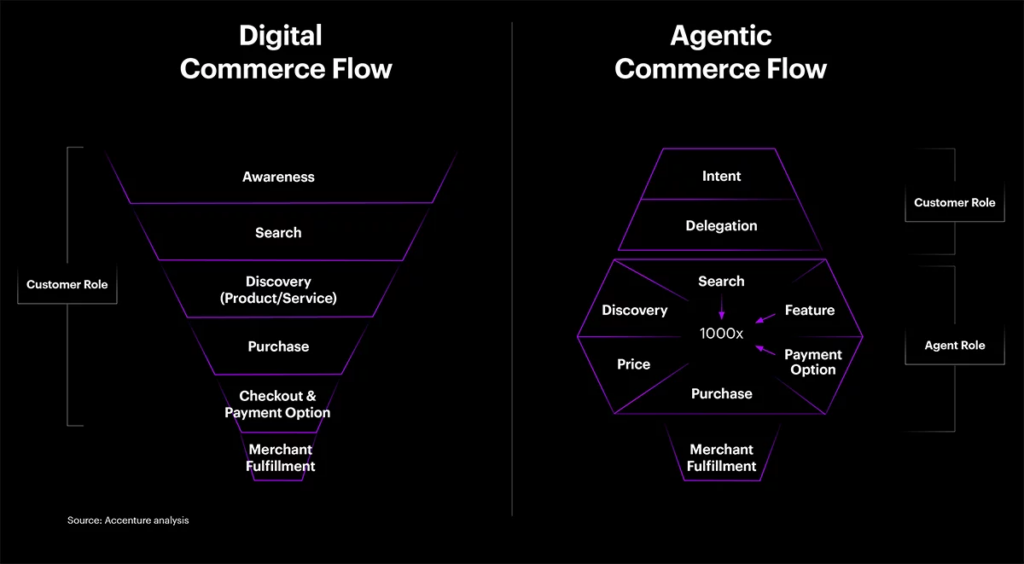
Coming back to our topic agentic commerce: here the forecasts already contradict each other. eMarketer expects AI platforms to reach 1.5% of US retail e-commerce in 2026, about $20.6 billion. Menlo Ventures forecasts $100 billion in agentic purchases within 12 months (MediaPost). The coverage we read states neither region nor definition. Both numbers cannot describe the same thing, and we honestly doubt the higher one.
Then there is the OpenAI story. Instant Checkout launched in September 2025 with the promise of more than a million Shopify merchants. By February 2026 only around 30 were live according to Forrester analyst Emily Pfeiffer, and Shopify’s president reportedly put it at about a dozen (Lengow). In March 2026 OpenAI said checkout was “moving to apps”: products are found in ChatGPT, purchases happen on the retailer’s own site. Walmart reportedly saw purchases inside ChatGPT convert at about a third of the rate of shoppers sent to its own site. A Semrush survey from December 2025 (1,030 US shoppers with AI experience) fits the picture: 50% had bought something after researching with AI, only 22% had ever bought directly inside an AI tool (Digital Applied). So AI works as a research assistant. The money still changes hands on the merchant’s site. Several of these figures come from press reports and agency summaries, not primary data, so treat them as direction, not measurement.
Who sees the ad when the agent buys?
This is the question the advertising industry should answer first. Advertising makes its money by exposing real people to communication. It assumes the person who sees the ad also makes the decision. If an agent filters the options first, the human sees a shortlist or no choice at all, and every ad aimed at that human is worth less. Dipanjan Basu of Fireside Ventures calls it a move from share of voice to share of model (exchange4media). Paul Low of PMG goes further: digital advertising will shift from targeting people to influencing the agents that shop for them (MediaPost).
Should brands then show ads to agents? We honestly doubt the question makes sense. An agent has no attention to win, no memory of a brand, no feeling about a jingle. Advertising to an agent is not advertising. It is either data supply or a paid slot in the agent’s answer. The paid slot is the old auction at a new address, and OpenAI is reported to put advertising at the centre of its revenue plans (Lengow). That raises the better question. An agent that sells slots to brands is no longer the consumer’s agent. Who audits whose interest it serves?
Do brands have any influence on the decision logic of agents?
Early evidence says little, and not with classic tactics. Jafar Sabbah and Oguz Acar ran thousands of simulated shopping rounds across four AI models and four product categories (HBR). Star ratings were the only cue that consistently raised choice in the expected direction, and higher price reliably lowered it. Scarcity, countdown timers, strike-through pricing and vouchers had unstable, model-specific effects. More advanced reasoning models looked sceptical of overt persuasion. Microsoft’s Magentic Marketplace simulation points the same way. Agents struggled with too many options, favoured the first acceptable offer and fell for manipulation such as misleading descriptions or hidden prompts. They decided better when product data was clear and structured (Computerworld).
Two lessons here: first, manipulation works on weak agents and gets punished by strong ones. We know this arms race from black hat SEO. Nobody outside the model vendors controls the technical behaviour of these systems, and anyone selling you “agent optimisation” is selling a promise they cannot keep. Second, what remains is price, reviews and clean data. That is product, price and place. Promotion is the one P the agent ignores, which makes this an odd sequel to our trailer department piece.
What we would do now
Fix your product data first: stock, delivery time and shipping costs must be correct, because stale data is one reason the first checkouts stalled. Keep prices competitive and reviews real. Track whether AI systems name your brand, but do not rebuild your media plan around a channel with low single-digit share. And keep building the brand. A shortlist made by a model still draws on what the model knows about you.
To sum up: agentic discovery is real, agentic buying is a small and unproven slice, and the forecasts repeat the voice commerce mistake of treating technical capability as consumer demand. The advertising question is serious but early. For now, humans still decide where the money goes, and agents mostly shorten the path to the merchant’s site. Evaluate carefully before restructuring anything, because FoMo is not a strategy.
- Legit or overvalued: 4/5
- FoMo Factor: 5/5