
In an environment of compounding crises, accelerating technology shifts, and increasingly fragmented media landscapes, resilience has become a core marketing capability – not a nice-to-have. Organizations that can sense market changes and adapt their decisions rapidly outperform those locked into annual planning cycles and rigid campaign structures.
This is what agile marketing is about. Not post-its and stand-ups. Not running sprints for sprint’s sake. Genuine organizational and cultural adaptability – applied to marketing.
Only a modern and agile marketing organization is able to create future-orientated marketing.
What Is Agile Marketing?
Agile marketing is the application of agile principles — originally developed for software development — to marketing teams and organizations. It prioritizes rapid iteration, cross-functional collaboration, data-driven learning, and responsiveness over fixed plans and siloed execution.
The Agile Marketing Manifesto, first developed in 2012, defined five core values:
- Focusing on customer value and business outcomes over activity and outputs
- Delivering value early and often over waiting for perfection
- Learning through experiments and data over opinions and conventions
- Cross-functional collaboration over silos and hierarchies
- Responding to change over following a static plan
These values are deceptively simple. The difficulty isn’t understanding them — it’s building the organizational conditions where they can actually work.
Marketing Agility vs. Agile Marketing – Why the Distinction Matters
These terms are often used interchangeably but they describe different things.
Agile marketing refers to the application of specific frameworks and practices: Scrum ceremonies, Kanban boards, sprint planning. It is a method.
Marketing agility is broader: “the extent to which an entity rapidly iterates between making sense of the market and executing marketing decisions to adapt to the market.”
A team can run Scrum religiously and still be completely inflexible in how it responds to market signals. Conversely, a team with no formal agile framework can exhibit high marketing agility through culture, leadership, and organizational design.
The distinction matters because organizations consistently invest in agile tooling and ceremony while leaving untouched the structural and cultural factors that actually limit their adaptability.
What the Research Shows
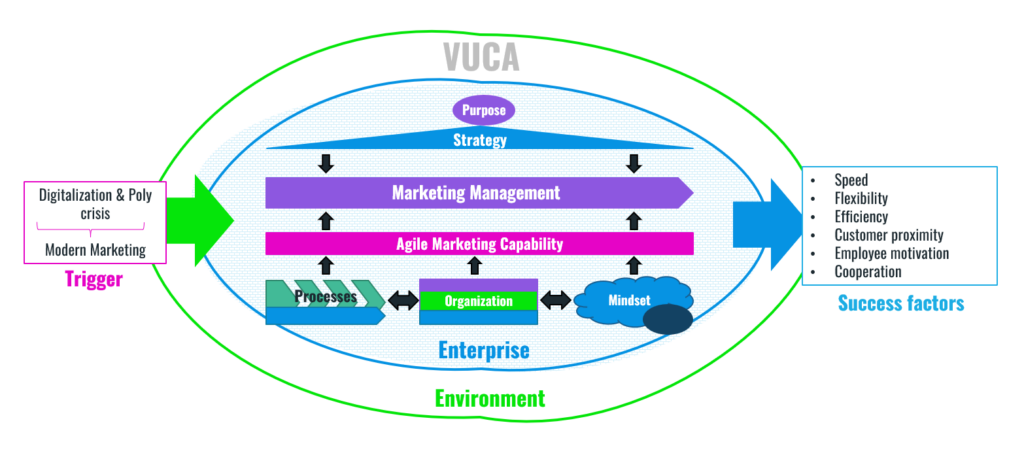
Research I conducted at MBA level at the Danube Business School – examining agile implementation across multinational enterprises – identified three core components that determine whether agile marketing actually takes hold:
Mindset. Adapting agile values to the organization’s own culture and context. Generic manifesto adoption rarely sticks. What works is translating the principles into language and practices that fit the specific organization.
Processes. Adapting frameworks like Scrum or Kanban for marketing realities, which differ significantly from software development. Marketing work is less modular, more dependent on external timelines, and often involves longer feedback loops than a two-week sprint assumes.
Organizational structures. The most overlooked factor. Functional hierarchies and agency-client models that haven’t been designed for agility will constrain even the best process implementation. Customer-centric team structures, clear governance, and the right agency setup are prerequisites — not afterthoughts.
The finding that practitioners most consistently underestimate: structure limits everything else. You cannot Scrum your way out of a broken operating model.
How to Bring It to Life
These are the practices that make a consistent measurable difference in real-world implementation:
Start with rituals, not frameworks. Before committing to full Scrum or SAFe, introduce two foundational practices: a daily prioritization check-in (not a status meeting) and a retrospective at the end of every project or sprint. These build the muscle memory for continuous improvement without the overhead of a full methodology adoption.
Make experimentation structurally safe. Teams won’t test-and-learn if failure gets punished. Leadership has to visibly model tolerance for fast, contained failures. This is a cultural change, not a process change — and it has to come from the top.
Redesign how you work with agencies. Most client-agency structures are inherently un-agile: annual scopes, monthly review cycles, siloed briefs. Agile marketing requires a different operating model — tighter collaboration loops, shared KPIs, and governance that enables fast decisions rather than delaying them.
Cross-functional is not optional. Real agility requires marketing to work fluidly with product, sales, customer service, and technology. If your marketing team is organizationally isolated, agile practices will hit a ceiling quickly regardless of how well the internal team executes.
When Outside Consulting Helps
Most agile marketing transformations stall not because people don’t understand agile — they stall because the structural and cultural changes required are hard to drive from within.
Common patterns where outside perspective accelerates progress:
- The framework trap — Teams adopt Scrum or Kanban but see no improvement because the underlying operating model hasn’t changed
- The agency friction point — Agile internal teams hitting a wall because their agency relationships weren’t redesigned alongside
- Leadership misalignment — Marketing leaders committed to agility but unable to build the organizational case upward or laterally
- Post-merger or restructuring — New team structures that need agile operating models designed from scratch rather than inherited
These are exactly the situations where experienced outside perspective shortens the path considerably.
Organizational Design & Agile Marketing Implementation →
Frequently Asked Questions
Is agile marketing only for large organizations? No. Agile principles are equally applicable in SMEs — and often easier to implement because structural complexity is lower. Right-size the practices: a three-person team doesn’t need a Scrum Master, but it does benefit from regular retrospectives and explicit prioritization.
Does agile marketing replace strategic planning? It shouldn’t. Agile marketing without strategic direction is just fast execution of the wrong things. The goal is combining clear strategic intent with the organizational flexibility to adapt how you pursue it. Strategy sets the direction; agility determines how you navigate.
How long does an agile marketing transformation take? Meaningful behavioral change typically takes 6–12 months. Structural change — redesigning team models and agency relationships — can be accelerated with external support, typically in focused 4–6 week engagements.
Ready to make your marketing organization more adaptive? Schedule a free 30-minute conversation →